
An engineering note on selecting small-to-medium density memory and audio amplifiers, covering ESMT's mainstream DRAM, NAND/NOR flash, audio ICs and power devices, with emphasis on solution combinations and design considerations.
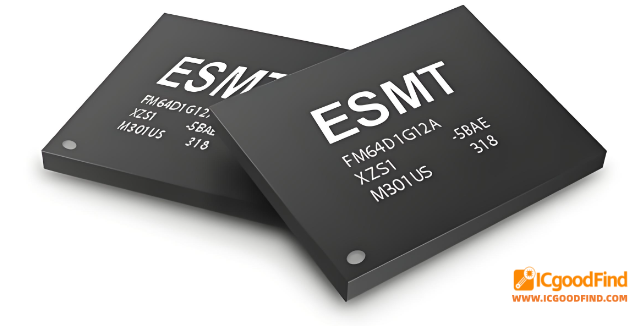
ESMT (Elite Semiconductor Microelectronics Technology Inc.) was established in Hsinchu Science Park in 1998 and listed in 2002. It merged with Ji Xin Technology in December 2005 and with Eon Silicon Solution Inc. (EON) in June 2016, with ESMT as the surviving company. After the merger the NOR flash line continued under the cFeon / EON brand, so the EN25Q series is now part of the ESMT portfolio rather than a separate vendor.
The portfolio falls into five blocks:
M12L is a 3.3 V synchronous SDRAM family covering 64 Mb, 128 Mb and 256 Mb densities, mostly x16 organization. M12L128168A, for example, is 128 Mb, 8 Mb × 16, 3.3 V, with 143/166/200 Mbps speed grades in a 54-pin TSOPII or 54-ball BGA package.
The speed suffix maps directly to clock frequency: -5T is 200 MHz, -6T is 166 MHz and -7T is 143 MHz. This matters for second-sourcing — the same density in a different grade is not automatically equivalent, because the controller timing was characterized against a specific grade.
Typical uses are display buffers, video frame buffers, main memory on industrial control boards, and mid-to-low-end controllers that need a parallel bus. TSOPII suits cost-sensitive designs that may require rework; BGA offers higher density and pin count.
The progression is straightforward:
What actually needs calculating is bandwidth versus bus width: whether the controller's DDR interface is 16-bit or 32-bit determines whether one x16 device or two in parallel is required; density should be derived from the frame-buffer formula (resolution × bit depth × number of buffers) rather than simply maximized. DDR2/DDR3 also impose far tighter requirements on trace length matching, reference planes and termination than SDRAM, so these must be planned at layout time.
Embedded systems assign flash two distinct roles: boot code needs random access, XIP capability and high reliability; data and firmware need capacity, low cost and erasability. ESMT's three flash lines map onto these requirements.
EN25Q is a SPI / Dual / Quad SPI serial NOR family ranging from 4 Mb (EN25Q40A) and 16 Mb (EN25QH16B) to 64 Mb (EN25QH64A), in SOP8 packages at 3.3 V.
Its value lies in few pins (SPI needs only four to six lines), direct XIP execution and a regular 4 KB uniform sector structure, making it suitable for bootloaders, parameter blocks and small firmware images. The EN25QH series supports Quad SPI, with read bandwidth several times that of standard SPI, easing the instruction-fetch bottleneck when code executes directly from NOR.
F50L1G41LB is a 1 Gb SPI NAND with single/dual/quad interface, 3.3 V, 104 MHz and an 8-contact WSON package; F50L2G41XA extends capacity to 2 Gb.
The positioning is clear: NAND capacity and cost at NOR pin count. Compared with parallel NAND it eliminates 8–16 data and command lines, shrinking PCB area dramatically; compared with SPI NOR it offers an order of magnitude more capacity at similar cost. The trade-off is mandatory bad-block management and ECC — SPI NAND ships with bad blocks, the controller or software must manage them page/block-wise, and it cannot be executed in place like NOR, so boot code typically has to be copied into SRAM first.
F59L1G81A is 1 Gbit (128 Mb × 8), 3.3 V, SLC, with an additional 32 Mbit spare area; F59L2G81A is the 2 Gb tier, available in 48-pin TSOPI and BGA packages.
SLC stores one bit per cell, giving better endurance and data retention than MLC/TLC, which suits frequently written logs, configuration and firmware update images. The parallel interface provides higher bandwidth than SPI NAND, helpful for fast sequential reads such as voice prompt libraries and font data. Designs still require ECC (typically 4 bit/512 B or better), a bad-block table and wear leveling.
A common layered arrangement is EN25Q for the bootloader, F59L/F50L for main firmware and data partitions. If the controller's Boot ROM supports SPI NAND boot, the NOR can be dropped entirely and a single F50L can handle both boot and storage, simplifying the BOM.
ESMT's audio ICs fall into two categories with entirely different roles.
AD22650 is a 2-channel line driver in TSSOP-14 at 5 V/3.3 V, delivering 3 Vrms with popless operation; AD22653B is the 2 Vrms version.
These are not power amplifiers but pre-stage line drivers: they convert a DAC's single-ended output to differential, raise it to 2–3 Vrms to drive a following amplifier or a long cable, and suppress the DC transient at power-up/power-down that causes pops. Typical uses are set-top boxes, Soundbar pre-stages and automotive audio head units.
All four are Class-D, layered by power and function:
Class-D design always involves four steps: an output LC low-pass filter (cutoff set by switching frequency and load), supply decoupling and PVDD routing, copper area for heat spreading, and EMI treatment (spread spectrum, gate slew rate, output trace length). Built-in power limiting and thermal control exist to sustain output under constrained cooling rather than to substitute for external heatsinking.
EMP8965-33VF05GRR is a fixed 3.3 V LDO providing a clean low-voltage rail for memory, audio pre-stages or an MCU. LDOs are often undervalued here: DDR VDD/VDDQ and analog audio supplies are ripple-sensitive, and feeding them directly from a switching converter couples switching noise into audio or memory timing — a post-filter LDO is the cheapest fix. Check dropout, quiescent current and PSRR.
These ESMT parts share a common trait: wide coverage and fine-grained tiers. Memory runs from 64 Mb SDRAM to 2 Gb DDR3, flash from 4 Mb NOR to 2 Gb SPI NAND, audio from line drivers to 2.1CH digital amplifiers — enough to assemble a complete mid-to-low-end audio/video or industrial control board. Selection is not about maximizing specifications but about fixing four things first — bandwidth, density, boot path and voltage domain — and then working back to the specific part and speed grade.
2026.11.18 Weekly Hot Picks: ESMT (Elite Semiconductor) Memory, Audio & Power Series (incl. cFeon/EON NOR Flash)
M12L128168A-6TG2N, EN25QH64A-104HIP, AD22650-QH14NAR, M12L64164A-7TG, M12L2561616A-6TG, M12L128168A-6TG, M12L64164A-7T, AD52068-QG28NRR, M14D5121632A-2.5BG2K, M12L16161A-7TG, M12L64164A-5TG, M12L16161A-7T, F59L1G81A-25TG, M15T2G16128A-DEBG2R, M12L2561616A-6TG2A, M12L128168A-7TG, M15T1G1664A-DEBG2CS, M15T2G16128A-DEBG2LS, EMP8965-33VF05GRR, M12L64164A-7TG2Y, F59L1G81MB-25TG2M, F59L2G81A-25TG, M12L128168A-6T, F59L1G81LA-25TG2Y, AD52580-QG28NAR, M14D5121632A-2.5B, M14D1G1664A-2.5BG2S, M15T1G1664A-DEBG2C, F50L1G41LB-104YG2M, M12L64322A-6TG, M12L2561616A-6T, AD52090-QG28NRR, EN25Q40A-104GIP, AD83586B-LG48NAY, M13S2561616A-5T, FM64D1G12A-5BAGE, M14D5121632A-2.5BG2A, M14D5121632A-2.5BG, F50L2G41XA-104YG2B, M13S2561616A-5TG, M12L16161A-5TG, M12L64164A-5TG2Y, AD22653B-QH14NAR, M12L64164A-7TG2C, M12L128168A-7T, M12L2561616A-6TG2S, M12L64164A-5T, F59L1G81MA-25TG2Y, EN25QH16B-104HIP2A, M13S5121632A-5TG
#ICGOODFIND #ESMT #EliteSemiconductor #SDRAM #DDR #DDR2 #DDR3 #NANDFlash #NORFlash #AudioAmplifier #PowerManagement #ElectronicComponents #Semiconductors
